
.svg)
How ClinIntell Works
Everything starts with your patient population — not individual charts or peer comparisons.


We Evaluate Clinical Severity at the Population Level
Your inpatient claims contain more information than most health systems ever use. Every claim reflects what your patients actually presented with — the conditions, the complexity, the clinical reality of your population. ClinIntell analyzes that data against standardized clinical definitions to establish what your population's severity should look like if every condition were documented accurately.
The result is a clinically expected CMI — specific to your patients, not benchmarked against other hospitals, and not dependent on what's already in your charts.
This is your baseline.

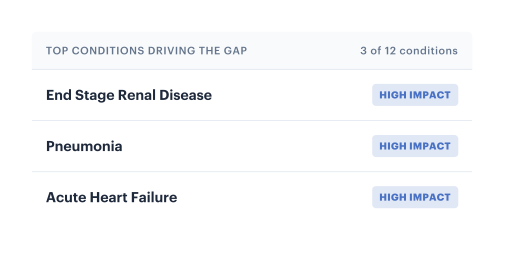


The gap is quantified — condition by condition, physician by physician
The difference between your expected CMI and your coded CMI can be measured each month. ClinIntell maps the gap across over 370 conditions, identifying which are being documented inaccurately and which physicians and departments are best positioned to close it.
That specificity matters. A population-level gap figure tells you how much is at stake. Physician-level attribution tells you where to act.



The right physicians get targeted education — and documentation changes at the source
Most documentation improvement efforts work backwards. CDI and coding review a claim based off the information in the chart, a query may go back to the physician and then the claim is submitted. The chart might get updated. The next patient starts the same cycle over again.
ClinIntell works differently. Because we know which conditions are being documented inaccurately and which physicians have the most opportunity, education can be precise — the right condition, the right physician, before the next claim is submitted.
Physicians see their own documentation patterns compared to their peers and receive guidance in clinical terms rather than coding language. That's a conversation physicians haven’t had before, and one they find genuinely useful.
What this looks like in practice

