Here are the questions we get the most. If you don't see what's on your mind, reach out to us anytime!
Contact usClinIntell is a patient population severity evaluator that uses predictive analytics to assess how accurately clinical severity is being captured across an organization’s inpatient population. By identifying underreported severity patterns and high-impact opportunities, ClinIntell helps physician teams focus documentation and coding improvement efforts where they matter most—supporting stronger clinical reporting, more accurate MS-DRG severity capture, and sustainable performance improvement.
ClinIntell works with all acute care organizations except:
ClinIntell supports both healthcare leaders and providers by delivering clear, population-based severity reporting insights and performance transparency.
Key roles that benefit include CFOs and finance leaders, CMOs and clinical executives, physicians and advanced practice providers, and CDI/quality leaders—helping teams align on improvement opportunities, strengthen documentation accuracy, and drive sustainable severity reporting performance.
ClinIntell uses a multi-layered approach to protect data and support compliance, including strong technical safeguards (encryption and access controls), administrative protections (staff training and routine audits), and established procedures (incident response and business continuity planning).
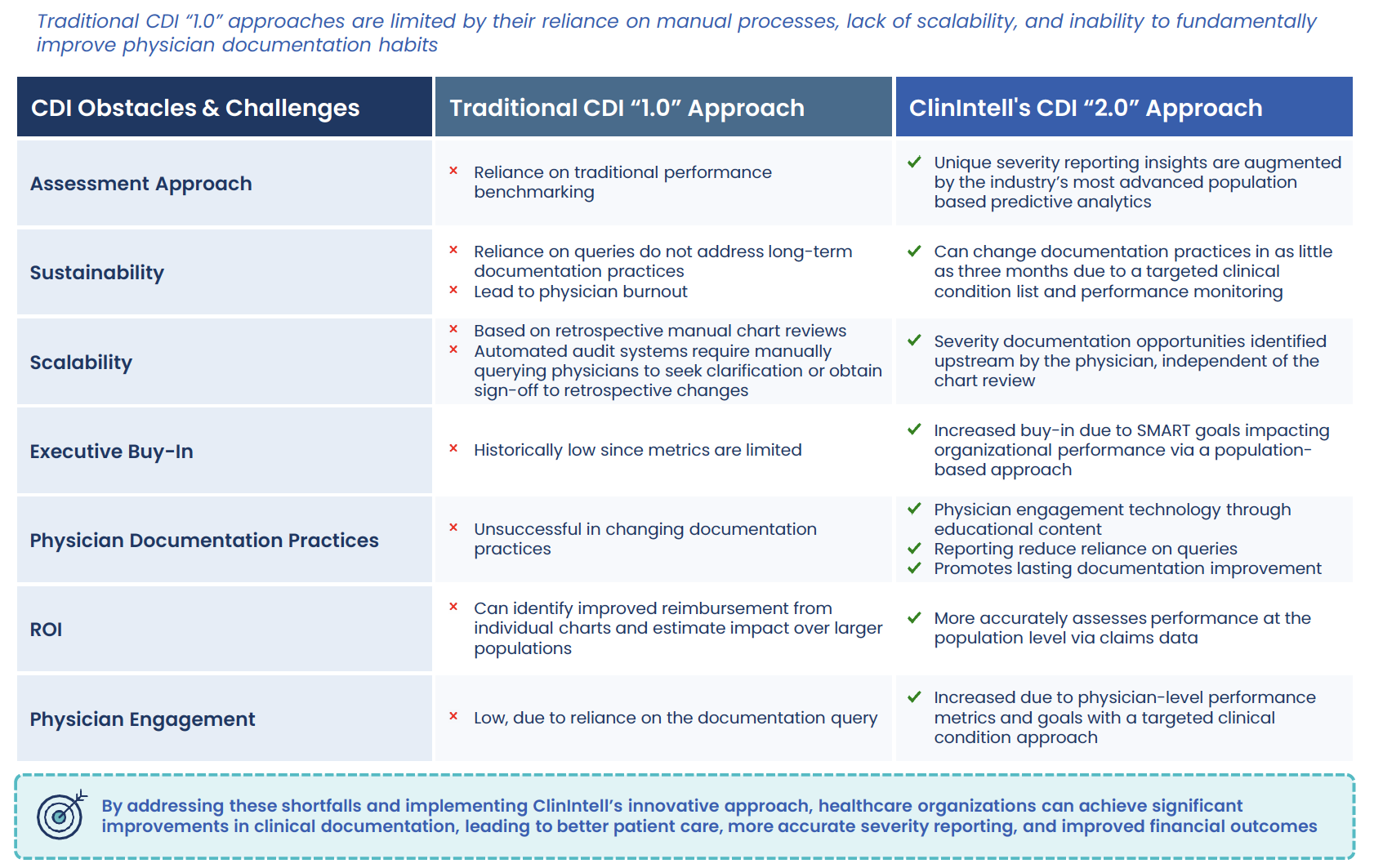
No. ClinIntell is not a CDI or point-of-care documentation tool. It does not perform chart reviews, generate queries, or manage encounter-level workflows. Instead, ClinIntell analyzes claims data at a population level to identify system-wide documentation and coding patterns, quantify financial and quality impact, and guide physician-led strategies to improve severity reporting performance at scale.
ClinIntell delivers the industry’s only proven, predictive population severity insights based on your hospital’s actual claims used as a proxy for your unique and ever changing inpatient population—not benchmarking cohorts—so results are more relevant and timely.
Reporting is available within 24 hours of final monthly claims, includes credible provider-level attribution (including APPs and residents), and supports realistic SMART goals paired with actionable improvement strategies.
ClinIntell is a SaaS platform with high-touch client support. Our subject matter experts guide clients through implementation, strategy, and ongoing maintenance, while helping teams build long-term proficiency with ClinIntell’s severity documentation metrics for sustainable improvement.
ClinIntell’s SMART Strategy helps organizations set customizable, attainable 80/20 goals tied to key metrics like CMI and quality risk adjustment. Using predictive analytics, it identifies the highest-impact severity documentation opportunities and clinically relevant conditions within your unique patient population.
ClinIntell uses a validated predictive model to assess expected severity reporting within your unique patient population. By analyzing inpatient claims monthly, the platform identifies documentation and coding gaps based on what your population indicates should be captured, without relying on external benchmarking.
The ClinIntell Mobile Training App helps providers understand their documentation performance and improve it through tailored, 2-4 minutes, clinically-focused education.
It delivers data-driven training on high-opportunity conditions, personalized performance insights, and ongoing progress tracking—promoting accountability and continuous improvement across the provider team.
ClinIntell gives clinical leaders an intuitive dashboard to track provider training progress, monitor performance trends toward goals, and share individualized provider reports.
Leaders can also identify a “Condition of the Month” and quickly distribute standardized definitions, documentation tips, and training videos—making it easy to drive improvement with minimal effort.
Yes, ClinIntell can customize the application specifically to the specialties unique to your facility and report insights on each specialty.
ClinIntell’s advanced attribution methodology links claims to the providers who made significant contributions to documentation of an encounter by identifying who authored key note types and when they were written. This supports accurate provider-level reporting across teams and services, recognizing all clinicians who meaningfully impact severity documentation.
Once data is received and validated, ClinIntell can publish results within 24 hours.
Finalizing provider groupings and placement typically takes 1–2 weeks, depending on input and confirmation from the client organization.
No, ClinIntell is a cloud-based solution, so there is no need to integrate into the EMR or access hospital IT networks.
ClinIntell does not require additional chart review staffing or new hires. Successful long-term improvement typically depends on strong clinical leadership (often per physician group) and a designated onsite point of contact trained as a Super User.
ClinIntell provides data extract specifications for coded and notes data. Your team submits a test extract for validation, and any issues are identified within 24 hours. Once finalized, baseline data (typically back to January 2019) is delivered and the ClinIntell application can be fully stood up within 24 hours.
ClinIntell does not impact the workflow of Clinical Documentation Specialists. Population based severity reporting insights are utilized by healthcare executives and providers.
Yes. ClinIntell’s analytics will provide educators with a data-driven strategy which includes the target list of clinically relevant (to the selected specialty) conditions that will have the highest impact on achieving the group’s performance goals.
Clinintell’s SaaS application is priced as a subscription service taking the following variables in account:
No. ClinIntell includes comprehensive training and ongoing support as part of your agreement. There are no additional service fees or per-user costs.
Yes. Please contact us at info@clinintell.com for more details.
ClinIntell measures impact by comparing your baseline severity documentation performance (typically the most recent 12 months) to predicted severity using Observed vs. Expected CMI. Progress is quantified as CMI gap closure, showing measurable improvement after SMART Strategies are implemented.
ClinIntell offers configurable monthly reports for multiple audiences, including:
Yes. ClinIntell predicts risk adjustment opportunities and the potential quality impact of key clinical conditions for initiatives such as Value-Based Purchasing, Star Ratings, Mortality, Readmissions, and HCC. Users can rank and select conditions by opportunity and instantly see the estimated improvement impact for each initiative.
ClinIntell does not track or analyze denials. Instead, it focuses on improving physician documentation accuracy and severity capture at the source, which can strengthen the clinical foundation used in audit and appeal processes. Individual results may vary.
ClinIntell analyzes final submitted claims, so it does not directly separate coding gaps from documentation gaps. However, coding-related issues often appear as broad, system-wide patterns, while underperformance within the same service line typically points to provider-level documentation differences.
ClinIntell analyzes all-payer claims monthly and does not separate Medicare-specific reporting. Using all claims increases sample size and improves accuracy—especially for provider-level performance—and supports payer-agnostic insights that drive better documentation practices by physicians.
ClinIntell analyzes severity documentation across all specialties and service lines using the full inpatient data set. While the assessment is built on organization-wide data to ensure accuracy and context, reporting can be filtered to focus on specific service lines as needed.
ClinIntell drives engagement through:
ClinIntell provides short, clinically-based training modules tailored to each provider’s highest-impact documentation opportunities—without CDI or coding jargon.
Through the mobile app, physicians access 2–4 minute videos with learning checks, customizable proficiency scoring, and progress reports that promote accountability and sustained improvement.
ClinIntell promotes accountability through transparent, objective provider-level performance insights and the CMI Documentation Score, which measures severity documentation across a physician’s inpatient population and can be utilized as a metric in the group’s annual incentive structure.
Monthly reports highlight trends and opportunities, while mobile app training scores and progress tracking reinforce engagement through feedback, visibility, and friendly competition.
ClinIntell supports regulatory compliance by completing CMS’s annual Data Management Plan Self-Attestation Questionnaire (DMP SAQ) and maintaining SOC 2 Type 2 compliance, with an attestation report issued annually.
ClinIntell protects patient data through layered security, including encryption and access controls, staff training and routine audits, and established incident response and business continuity procedures. ClinIntell further strengthens protection by keeping all data within a fully air-gapped environment throughout its lifecycle.
ClinIntell maintains a SOC 2 Type 2 attestation, providing independent third-party validation that our security, availability, and confidentiality controls are designed appropriately and operating effectively to support HIPAA compliance and protect sensitive data.
Yes. ClinIntell offers training for both new and existing users through ClinIntell University, featuring free self-paced courses, and the ClinIntell Help Center, which includes step-by-step guides, feature overviews, and troubleshooting resources for the web and mobile apps.
ClinIntell updates its algorithms annually to align with CMS IPPS Final Rule and MS-DRG reimbursement changes. Updates also incorporate the latest ICD-10 codes, HCCs, and Elixhauser conditions, plus an additional year of Medicare and HCUP all-payer claims data to maintain accuracy and strengthen predictive performance.

.svg)